

by Garry Brough, Lead for Peer Learning, Partnerships & Policy
I was born in May 1967, two months before gay sex was decriminalised in the UK, with the age of sexual consent for gay men then set at 21. This was eventually lowered to 18 in 1994, but it took until 2001 to finally reach equality with the heterosexual age of consent at 16. It’s also worth noting that this was the first point at which British law finally recognised and included lesbian sexual acts!
While groups such as the Gay Liberation Front, Stonewall and Outrage! mounted and maintained the fight through those years to equalise the age of consent and gain validation and acceptance of our life experiences, there was ongoing pushback against acceptance.
This stated that a local authority “shall not intentionally promote homosexuality or publish material with the intention of promoting homosexuality” or “promote the teaching in any maintained school of the acceptability of homosexuality as a pretended family relationship”. In effect this banned the teaching or discussion of anything relating to to being gay or expressing some form of gender diversity, saying loud and clear that while homosexuality might be just about tolerated, these things should not be discussed openly with young people.
So how did all that affect a young gay man growing up in a South Wales mining village? Society as a whole frowned upon homosexuality in the 1970’s and it was a common insult, especially for a boy who hated sports. In and out of school, I received daily abuse for being a ‘poof’ – name-calling, spitting, punching, stone-throwing. I was taunted with homophobic insults before I had any grasp of what being gay meant.
So, when I did reach awareness of my attraction to other boys, around the age of 12, it was a difficult adjustment. How could I accept being ‘gay’ without also taking on all the judgement that my peers and society heaped upon that ‘lifestyle’? I’d like to say that I shrugged it off, and to a large extent that’s what I did on the outside, embracing my difference and the freedom of the 80’s to express myself by growing and dying my hair, wearing makeup, as part of the New Romantic and Goth music scene. My main defence was my small circle of female friends – a band of misfits who went clubbing together locally and in Cardiff.
This, at the age of 17, is where I was first introduced to the gay scene, by someone a year older from the next town who would drive down to the city on the weekend. We would go to the one gay pub and then go dancing in the only gay club. Both venues were a genuine mix of lesbian, gay, bisexual and trans people, and the music was HiNRG and the chart pop of gay and gay-appearing artists such as Bronski Beat, Dead or Alive, Soft Cell, Divine, Pet Shop Boys, Culture Club and Erasure.
It should, however, be noted that these weekends of freedom and that sense of acceptance were fuelled by a lot of alcohol!
That is also when I told my parents I was gay. While they were supportive and loving, they asked me not to ‘commit’ to anything, as it ‘might be just a phase’. They also spoke of their fear of me being gay in the era of AIDS – this was 1984 and there was lots of fear and a lack of information. I recognised their love and concern, but it still felt like they wanted me to be anything other than gay, and it was hard not to take that personally.
When I moved to London for college the following year I even humoured them by agreeing to a ‘new start’ – grudgingly cutting my hair short and taking off the makeup. The ‘new me’ lasted a full week, during which I felt like I was in some kind of awful man drag and denying an essential part of me by pretending to be something I didn’t feel I was – a boy.
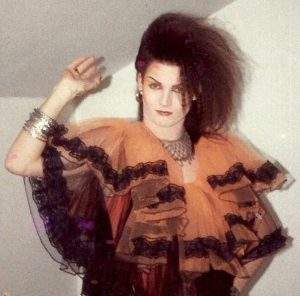
So I grew my hair and felt a freedom to be myself in London that I had never experienced in Wales. The 80s in London were such a melting pot of tribes and styles that it was easy to be gay and goth and have different venues to go to every night of the week which welcomed both. The club scene images from the TV show ‘It’s A Sin’ are the closest representation I’ve seen of what it felt like to live in that era in those clubs, and like the programme, it was only a matter of time until my world started to be impacted by HIV and AIDS.
A guy I was dating had a few friends who were living with HIV – they were lovely guys, we went clubbing together and I saw the difficulties they had with their health. I had started testing for HIV in 1985 when it became available and went through an annual ritual of waiting the two weeks for results. I did my best to practice safe sex, but in those days every encounter was tinged by the anxiety and unspoken potential presence of HIV.
Eventually though, the toll of living my life in clubs caught up with me, my college work had suffered and I crashed, admitting that I had a real problem with alcohol. I stopped drinking and started the process of recovery. I worked through the psychological damage of not having dealt with the feelings of worthlessness and homophobia that I had internalised from growing up in an environment which did not accept my sexuality.
I started to deal with my anger and rage from my youth and was finding a sense of acceptance for who I was. Then, eight months later in 1991, my annual HIV test came back positive.
The story of how I dealt with the diagnoses of both HIV and AIDS are less important here, since having worked through internalised homophobia, I did not internalise the stigma of my HIV diagnosis. As a result, I was able to make different choices that supported my health and allowed me to tell all those close to me, who accepted and supported me through those tough years.
While it’s impossible to separate the fears about AIDS of the general population from the prevailing homophobia of the age, the sheer cruelty and visibility of the disease meant that sex and sexuality were talked about far more publicly than would have been done otherwise. Much-loved celebrities sharing their diagnosis (though usually only just before they died) started to change perceptions of who might be gay.
The vocal and visible support from people like Princess Diana and Elizabeth Taylor both humanised the condition and those living with it. Perceptions were starting to change. The advent of effective medication meant that while HIV slipped from mainstream visibility, LGBT+ people have become more comfortable and confident in coming out and opening up about their sexuality.
We had fought a plague and were not going to sit quietly in a closet. The equalising of the age of consent in 2001 was the first step towards the other legal advances, with Section 28 being repealed in 2003. 2005 saw trans people win the right to apply to change their legal gender, same sex civil partnership rights came into law, as did the right of same sex couples to adopt. Full marriage equality took until 2014 in Great Britain, with Northern Ireland only following suit to legalise it in 2020.
Clearly, the history of LGBT+ rights is modern history, and while so much progress has been made in my lifetime, that progress and its continuation is not guaranteed. We cannot be complacent and think that these battles are won, since in so many countries, hatred and division are being sowed, legislation is being repealed and rights taken from our community. In the UK, we are seeing the same blaming and scare-mongering rhetoric aimed at trans people that we saw against gays in the 80s, and this is happening even within the LGBT+ community.
So, I call on each of you, this LGBT+ History Month, to come together and fight for all of our rights to be who we are and to love who we choose, and to support each other in this fight – united we stand, divided we fall. We must also fight for the rights of others who are oppressed, whether they be women, people of colour, migrants, sex workers or drug users. We must stand shoulder to shoulder against oppression and injustice in all its forms.
This year Pride in London celebrates 50 years since the first LGBT protesters took to the streets to claim their space and demand equality. With the 2022 theme of ‘Visibility, Unity and Equality’, I will be marching with Positively UK on July 2 and hope to see you with us on the streets of London. If you would like to join us, please get in touch with cohanlon@positivelyuk.org