

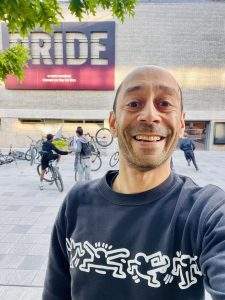
Our trustee Ant Babajee (he/him) got to watch Pride the Musical on the day of our National Conference of People Living with HIV. Reflecting for Pride Month, he writes about Mark Ashton, Jonathan Blake, HIV and trade union activism, and why this joyful story of solidarity still feels urgent today.
What I’m here to say to you tonight — and don’t worry, it won’t take long — is thank you. Because what you’ve given us is more than money. It’s friendship. And when you’re in a fight as bitter and as important as this one, against an enemy, so much bigger, so much stronger than you — well. To find out that you have a friend you never knew existed — it’s the best thing in the world.
On Easter Monday 2026, I travelled to Cardiff — by train, and sadly not in a minibus full of lesbians and gay men — to see Pride the Musical at the Sherman Theatre. Anyone who knows me knows that Pride (2014) is my favourite film. Not “one of”. My actual favourite. But what I sometimes forget is that, before I saw the film, I didn’t actually know the story of Lesbians and Gays Support the Miners. I knew Gay’s the Word bookshop in Bloomsbury very well from my years working at the legendary and much-missed Drill Hall theatre and arts centre, but my first encounter with LGSM came at a special preview screening of Pride arranged for HIV and sexual health outreach volunteers. I went in expecting a good film. I came out with a new piece of my history.
That screening opened a door for me. It introduced me to a story of queer people and working-class communities finding one another in the middle of Thatcher’s Britain — at a time when miners were under attack and gay men were being demonised during the early years of the AIDS crisis. Years later, seeing that same story brought to life on stage in Wales felt incredibly moving. The Sherman Theatre preview run took place before the production heads to the National Theatre’s Dorfman Theatre from 11 June to 12 September 2026. There was something very special about seeing it in Cardiff first, so close to the South Wales communities at the heart of the story.
The National Theatre describes the show as “joy-filled”, “funny” and “fierce”, and that feels exactly right. But for me, the thing that stayed with me most was the reminder that joy and solidarity are political acts.
And then there is Mark Ashton. I admire Mark so much. He was only 24 when he co-founded LGSM with Mike Jackson after collecting money for striking miners at the 1984 London Pride march. That fact alone blows my mind. At an age when so many of us are still working out who we are, Mark was building a movement that would change queer and trade union history.
What I find so inspiring about Mark is that his politics were not vague or sentimental. He understood solidarity as action. LGSM was not about symbolic allyship; it was about raising money, building relationships and standing alongside mining communities when they were under attack. In 2026, that kind of solidarity feels just as urgent now as it did then.
I was reminded of this recently when I went to Reds in the Rainbow: A night dedicated to Mark Ashton at the Triangle in Deptford. The event was described as “a night of resistance, music, and radical solidarity”, honouring Mark’s life and legacy through politics, culture, community, music, archive footage and dancing. It felt like exactly the right way to remember him: not as a saintly figure trapped in history, but as someone whose ideas still ask something of us.
The event’s framing really stayed with me: “We don’t inherit these histories to admire them. We inherit them to continue them.” That is how I feel about Mark Ashton. I don’t just admire him because of what he did then. I admire him because his example still challenges me now. That lesson has shaped so much of my own activism. Over the past few years, through UNISON, I’ve been proud to campaign on HIV stigma, LGBT+ rights and workplace equality — because our rights are never won by one community acting alone. I’ve written and spoken before about how HIV has changed medically, but stigma has not disappeared; about how people living with HIV deserve dignity, compassion and respect; and about how trade unions can be powerful allies in making workplaces safer and fairer.
Watching Pride the Musical, I kept thinking about that connection between labour movement activism and queer liberation. LGSM understood something beautifully simple: if the same newspapers, politicians and systems are attacking us, maybe our struggles are connected.
That lesson still matters. Whether we are fighting HIV stigma, transphobia, racism, poverty, anti-union laws or attacks on public services, solidarity cannot just be a slogan. It has to be something we practise every day — solidarity forever.
And then there is Jonathan Blake.
It has been genuinely wonderful to get to know Jonathan. He is not just a character in my favourite film; he is a living link to a history that changed all of us. Jonathan was one of the first people diagnosed with HIV in the UK, an early member of LGSM, and is now one of the country’s longest-surviving people living with HIV. In the film, he is played by Dominic West; in real life, he carries a story of courage, grief, humour, survival and extraordinary generosity.
One of the things I have loved in the more than a decade since Pride was released is how much more nuance and celebration there has been around Jonathan’s story. The film introduced so many of us to him, but it could only ever show part of who he is. Since then, Jonathan has been increasingly recognised not just as “the Dominic West character”, but as a long-term HIV survivor, activist, storyteller, community elder and living witness to an extraordinary period of queer history.
That matters. HIV history is too often told through loss alone. Jonathan’s story contains loss, of course, but it also contains pleasure, humour, sexiness, politics, love, resilience and survival. In his National HIV Story Trust testimony, Jonathan reflects that Pride is not a film about AIDS, but that it is impossible to separate that period from what was happening in the gay community in the early 1980s. That feels so important to me: the story of LGSM is also part of our HIV history, our trade union history and our queer survival story. As someone living with HIV myself, I find that deeply moving. I was diagnosed in 2007, and I’ve written before about the isolation I felt back then — and how peer support helped me move from surviving to thriving. Jonathan’s life reminds me that our HIV history is not abstract. It lives
in people. It lives in stories. It lives in the people we lost, the people who fought, and the people who are still here, still speaking, still dancing, still demanding better.
That is why Pride the Musical hit me so hard. It is not nostalgia. It is not simply a stage version of a film I love. It is a challenge: who are we standing with now? Who needs us to show up? And what could change if we were brave enough to build alliances across difference?
The music helps that message soar. With Matthew Warchus and Stephen Beresford reunited from the film, and original music inspired by protest anthems, pop, rock, disco and Welsh choral traditions, the show feels communal in the best possible way — like a rally, a remembrance, a night out and a call to action all at once. When the film came out in 2014, U=U [Undetectable equals Untransmittable] was not yet the widely celebrated message it is today. We knew antiretroviral treatment had the power to save lives — I am living testament to that — but the simple, life-changing clarity of U=U had not yet fully broken through into public consciousness. More than a decade later, it is one of the most important messages in HIV activism: a message of science, dignity, confidence and freedom. That is part of why it felt so special recently to take part in the U=U Community Quilt — a living artwork made from thousands of selfies from people living with HIV and allies, stitched together to spell out U=U. The quilt is a way to re-imagine the AIDS Memorial Quilt for the current era of U=U, with 4,000 photographs transformed into three large quilt panels through nine community stitching sessions and more than 1,500 hours of stitching.
Jonathan and I are both part of that quilt — as portraits and as stitchers. Sitting together at a stitching party earlier this year felt quietly profound: two people living with HIV, from different generations of the epidemic, literally helping to stitch the U=U message into a shared community artwork.
Jonathan’s story carries the terror and resilience of the earliest years of HIV; mine belongs to a later era of effective treatment, peer support and growing visibility. The quilt holds both those histories — and so many more — together.
And that is what has changed so beautifully in the decade since Pride was released. In 2014, the film introduced so many of us to Jonathan Blake as part of the LGSM story. Since then, there has been more space, more nuance and more celebration of Jonathan as a long-term HIV survivor, activist, community elder and joyful witness to how far we have come.
The story did not end with the film. It has kept unfolding — in conversations, in activism, in Pride events, and now even in stitches. And — without wanting to give too much away — Jonathan, played wonderfully by Samuel Barnett, gets the most fabulous number at the top of the second act.
I left Cardiff to travel back home to London, excited for the National Theatre run, but also grateful. Grateful for that THT preview screening in 2014 that introduced me to LGSM in the first place. Grateful for Mark Ashton, whose courage and politics continue to inspire me. Grateful for Jonathan Blake, whose story keeps unfolding with more richness, tenderness and joy. Grateful for the trade unionists, lesbians, gay men, HIV activists, friends and allies who refused to let fear have the final word.
I was so lucky to get a ticket to see the third performance at the National later the same day as our Positively UK National Conference of People Living with HIV. I remember that evening
pinching myself and reminding myself how fortunate I am to be connected to an amazing community of people also living with the virus, and how proud I am of the staff team and volunteers of Positively UK. Did someone whisper West End transfer? Because if Pride the Musical gets the life it deserves, I’ll be first in the queue.
I keep coming back to this: Pride is not only flags, glitter and parties, although I love those too. Pride is memory. Pride is protest. Pride is trade union solidarity. Pride is HIV activism. Pride is refusing shame. Pride is turning up for people who are under attack and saying: your struggle is our struggle too.
And, sometimes, Pride is getting on a train to Cardiff on Easter Monday to see the musical version of the film that changed how you understood your own history. Solidarity has the best songs.
– Ant Babajee has been a volunteer peer mentor with Positively UK since 2016 and one of our trustees since 2024.