

Medical education researcher and Positively UK volunteer Yiqing Wang sits down with Thomas Doukas, the co-leader of Positively Connected.
At his very first peer support meeting, one shy participant arrived expressing deep disappointment regarding his ability to connect with other gay men, stating, “I’m not going out to any clubs or bars because nobody likes me, people don’t talk to me”. Yet, after receiving encouragement from his peers to stay a little longer and engage with the group, he recently went out with a friend for a drink, returning to the session with a renewed sense of being comfortable in his own skin.
This kind of transformation is not uncommon among participants in the Positively Connected project. Initiated in February 2026, Positively Connected operates as a joint project between Living Well and Positively UK to establish an open meeting where people living with HIV can reduce loneliness, negotiate stigma, and build unforced social ties.
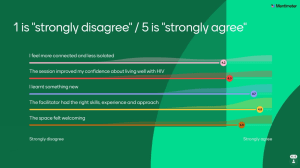
The group meetings are run by Thomas Doukas, a coach from Living Well who brings nearly seven years of experience, specialising in communication, career, and lifestyle coaching. A typical gathering unfolds inside a bright office meeting room, starting informally as participants arrive at different times to grab refreshments, have food and drinks, and chat before transitioning into the structured session.
The relaunched project marks a transition from Positively UK’s longstanding “Gay Men’s Project“, which had to be suspended in 2025 due to funding cuts. This was the only pan-London support group for LGBTQ+ men living with HIV.
But the community stepped up: Phil Dehaney ran a half-marathon for us; Anky and MC organised an amazing live DJ set; and many more donated to us online. AXA IM made a generous large donation of £2,500. It’s thanks to this legacy of fundraising and support that we were able to introduce Positively Connected in February 2026.
Positively Connected not only takes up the mantle of a pan-London support group for LGBTQ+ people living with HIV, but expands its remit to support a much wider demographic within the broader LGBTQ+ community.
Current participants are from various cultural backgrounds, younger and older, newly diagnosed and living with HIV for over 30 years. However, entering a peer support environment can initially present hurdles and social anxiety for new members. Thomas notes that the opening minutes of a meeting can be challenging and slightly chaotic as participants arrive at different times, gather refreshments, and talk, which may overwhelm newcomers. To alleviate such barriers, some members in the room actively share their own personal histories to put newcomers at ease, offering understanding from a perspective of, “we’ve been there, so we know”.
Inside the Room: Building Safety and Involvement
I bring “my empathy”, “big ears”, and “my experience of living with HIV for over 30 years”; I need “courageous candour”, “maybe friendship from the group”, “a safe space”, and “to manage relationship”. These are just a few of the colourful handwritten notes posted on the wall during a session. This display is a deliberate framework designed by Thomas to improve communication and involvement and ensure psychological safety from day one. Moving intentionally away from dry, traditional lecture formats, Thomas help the group co-create this collective “coaching contract”. He prompts participants to write down what they can bring to the room and what they require from the group in return. To maintain this interactive environment, he hangs this chart back up on the wall at the start of every meeting, serving as a visible reminder of their shared commitment to confidentiality, compassion, and mutual respect.
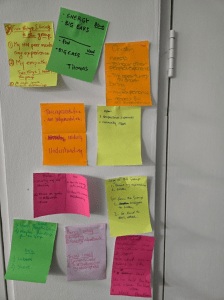
To keep this collaborative momentum going, Thomas introduces practical exercises like a “hot seat” goal-setting workshop. Members read a personal objective, while the rest of the room acts strictly as a non-judgmental sounding board, offering resources and support rather than evaluating the goal’s difficulty. Drawing on his background in Gestalt coaching, Thomas also treats internal disagreements as opportunities to build emotional awareness. “I’m very much attuned to ask people all the time how they’re feeling about specific things”, Thomas explains. “If Bobby says something to John, I will ask Bobby, how are you feeling about what John says? Just open a little bit the conversation”. These communication patterns have made sure every individual is listened to while learning to navigate different perspectives.
Beyond the Office: Shifting Perspectives and Real-World Connexions
A notable psychological shift observed through these regular dialogues involves the personal decision of sharing HIV status. Participants enter the programme at two opposing extremes: individuals who keep their diagnosis entirely confidential from friends, family, and partners due to social fears, and those who choose to disclose their status extensively. Thomas observed that through shared group dialogues, “these two extremes get a little bit closer”. Listening to alternative experiences has allowed secretive individuals to consider making small disclosures to a trusted friend, while highly open individuals recognise the utility of establishing boundaries to maintain better control over their personal information.
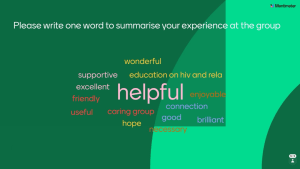
Besides, the broader impact of this newfound confidence is increasingly evident outside the confines of formal sessions. Participants recently co-ordinated a spontaneous trip to a local pub on their own initiative following a session. Thomas views this organic socialisation as concrete evidence that members are successfully establishing unforced community connexions without relying on a structured clinical environment.
For individuals currently navigating the initial shock of a diagnosis or dealing with severe isolation, Thomas’s direct recommendation is straightforward: “It can be so overwhelming to have a diagnosis. Don’t panic, don’t panic. Find other people that you can talk, you can share experience”.