

10th October marks World Mental Health Day – a day to raise awareness of mental health issues around the world, and among our communities.
In this blog post, our CEO Silvia Petretti calls for a system change and healthcare based on holistic whole-person approach that acknowledges the range of experiences and inequalities of people living with HIV.
“I grew up in a household where mental health was a big issue. My mother was sectioned a few days after I was born. She was in and out of psychiatric hospital a lot during my childhood. It was very difficult as a child to deal with mum’s absence, her ‘challenging’ moods and the effects of powerful psychiatric medications and electroshocks, which were commonly used in the 70’s. The fact that she was a feminist, wanted to divorce and be free, that she did not want to conform to standard notions of femininity and her role as a woman, exacerbated her mental health problems, and also shaped how the psychiatric system and the family dealt with her.
It was really tough to feel very early on in my life the stigma linked to mental illness. I grew up feeling different, feeling intensely the shame of my family for what my mum was going through. It may be that those early traumas also drew me to be a ‘risk’ taker, to feel like I could never belong, not to have firm boundaries, enough self-esteem to protect myself from HIV. This was compounded by growing up in a very patriarchal society, in Italy, which objectified and sexualised young women and didn’t provide a context where I could be safe.
Mental illness and HIV share in common huge stigma. I believe that in both cases stigma grows on ignorance and silence. This is why I feel it is important to break taboos and talk about it, even if it is hard to expose one’s wounds. As legendary AIDS activists in Act Up used to say in the 90’s: Silence=Death.
Both HIV and mental illness create a world in which we feel separated, isolated, singled out and judged. A world of ‘Us’ and ‘Them’. We are often asked: how did you get it? How did you turn out this way? Maybe ‘othering’ ‘us’ makes ‘them’ feel protected? If ‘they ‘think that the ‘other’ is radically different from ‘them’, then ‘they’ can feel safe. An illusion of protection. However both HIV and mental illness can potentially affect any one, especially when shredded in silence, secrecy and shame.
At this point I need to also point out that poor mental health can affect everyone, however some groups, especially those who are most marginalised are disproportionately affected by it, and are also not receiving the care they need. In the UK, the MIND charity estimates that black people are much more likely to be sectioned, restrained and over-medicated more than anyone else in our mental health services – see report here. We also know that mental health problems such as depression, self-harm, drug and alcohol abuse are more common among people who are LGBTQ+. Those are also communities who are disproportionately affected by HIV.
Most of us have been affected by mental health issues directly, or because we care for a loved one with those challenges. Especially after 2 years of living in a ‘double pandemic’, living with HIV in the midst of the COVID-19 crisis, with so much loss, isolation, and uncertainty in our lives. If we add to this, in the recent months, a war on our doorsteps, the cost of living crisis, the environmental emergency, it is not a surprise so many of us are struggling to stay afloat.
In the midst of such a complex crisis there are no simple solutions. Having community spaces where to talk and to feel connection with others, places where we can be ourselves without being judged because we have HIV and /or also struggle with our mental health, is a life line. But it is not enough. To those of us who are struggling because of the socio-economic circumstances, I want to say: it is not just in our head…it is not purely an individual mental health problem. Actually, it is an appropriate response to a world that for many of us is violent, unjust, and dangerous.
This year Mental Health Day theme is Making Mental Health & Well-Being for All a Global Priority. If we are truly committed to this priority, our basic rights to safety, respect, healthcare, alongside food, and housing, are key. Sadly in the past months many of the people Positively UK supports because they have HIV have often have struggled with putting food on the table, paying their rent and surviving: our welfare and benefit advice service and referrals to hardship grants are over the roof.
If the world is committed to mental health and well-being for all, there needs to be systemic change. It is not just about access to therapy and anti-depressants. We need an approach to health and wellbeing that is truly holistic and takes into account the effects of trauma, injustice, exclusion and poverty. A system that recognises and addresses HIV stigma, racism, gender inequalities, homophobia and transphobia. It is definitely not just in our heads.”
Silvia Petretti, CEO at Positively UK
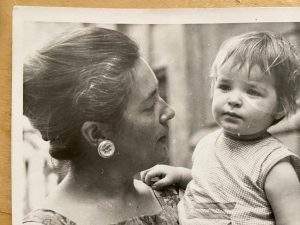
Young Silvia with her mother
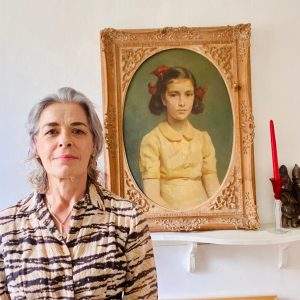
Silvia in front of her mother’s portrait